
logo

Geolocation in the Mobile Inspection App: GPS Accuracy and Capture Address

How GPS coordinate accuracy and address are determined during photo capture in the mobile inspection app. Cold start, accuracy ≤ 20 m, fallback, Huawei and Android.

Geolocation in the Mobile Inspection Photo Documentation App

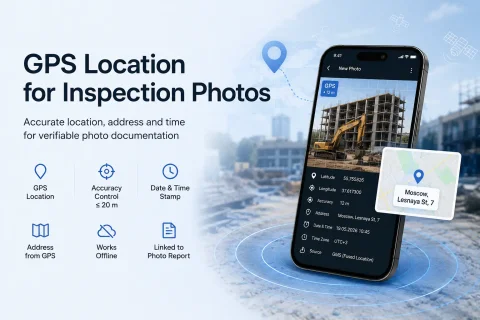
Geolocation in the mobile inspection app automatically captures GPS coordinates at the moment of shooting, determines location accuracy, and generates a textual address through reverse geocoding. The app uses the Android system's location infrastructure with support for:
  • Google Mobile Services (GMS)
  • Huawei Mobile Services (HMS)
  • Android Fused Location Provider (system provider)
The app does not calculate coordinates itself—it uses the official SDKs provided by the device manufacturer.

How GPS Coordinate Accuracy is Determined During Capture

What is accuracy in Android

Each location point contains an accuracy parameter (in meters). This is the radius of probable deviation from the reported coordinate. Example: accuracy = 12 m This means the device's actual position is within a 12-meter radius of the indicated point. The app enforces a quality control threshold: Coordinates are accepted when accuracy ≤ 20 meters. This ensures a balance between capture speed and data reliability.

Why GPS coordinates may vary by 10–30 meters

GPS accuracy on a smartphone depends on physical factors, not on the app's algorithm. Factors affecting geolocation accuracy:
  • number of visible GNSS satellites
  • urban density
  • signal reflection (multipath)
  • indoor shooting
  • weather conditions
  • use of Wi-Fi and cellular networks
Modern devices use Fused Location – combining data from:
  • GPS / GLONASS / BeiDou / Galileo
  • Wi-Fi
  • cell towers
  • motion sensors
Therefore, a spread of 10–30 meters is normal for mobile geolocation.

Levels of Responsibility for Coordinate Determination

When capturing coordinates, it is important to understand the division of responsibilities:

Level 1 – Satellite System (GNSS)

Physically determines the device's position.

Level 2 – Device System (Android / GMS / HMS)

Calculates:
  • latitude
  • longitude
  • accuracy
  • fix time

Level 3 – Mobile Application

The app:
  • requests coordinates
  • checks accuracy ≤ 20 m
  • records the coordinate at the moment of capture
  • saves it in the photo's data
  • displays the address
The app:
  • does not alter coordinates
  • does not snap the point to a building
  • does not manually adjust data
Thus, the captured coordinates are the official data from the device's system provider.

Photo Geolocation During Inspections: Capture Moment

Coordinates are recorded:
  • at the moment the shutter button is pressed
  • after verifying accuracy ≤ 20 m
  • together with the timestamp
This means the GPS coordinates reflect the device's actual position at the time of photo capture.

How Address is Determined from Coordinates (Reverse Geocoding)

After obtaining coordinates, reverse geocoding is performed: latitude + longitude → textual address The following are used:
  • Google Geocoding API (for GMS)
  • Huawei Location Kit (for HMS)
  • OpenStreetMap (fallback)
It is important to understand: The address is an interpretation of the coordinate, not its source. If the coordinate lies:
  • on a district boundary
  • in an industrial zone
  • in a new area without precise mapping
the address may contain:
  • only the city
  • the region
  • a street without a house number
The coordinates themselves remain accurate.

Why Mobile Geolocation is Not Geodetic

Smartphones:
  • do not use RTK correction
  • do not connect to high‑precision base stations
  • are not geodetic equipment
Typical GPS accuracy on mobile devices: Conditions / Average accuracy
  • Open area / 3–10 m
  • Urban environment / 8–25 m
  • Indoors / 15–50 m
The ≤ 20 m threshold corresponds to the industry standard for mobile inspection photo documentation. The ≤ 20 m threshold corresponds to the industry standard for mobile inspection photo documentation.

Key Features of Geolocation in the Mobile Inspection App

  • capture of GPS coordinates at the moment of shooting
  • accuracy check (accuracy ≤ 20 m)
  • support for GMS and HMS
  • fallback to the system Android provider
  • reverse geocoding to display the address
  • coordinates saved together with the photo

Summary

Geolocation in the mobile inspection photo documentation app is a combination of:
  • satellite systems
  • Android system services
  • accuracy verification
  • reverse geocoding
  • transparent capture algorithm
A spread of 10–30 meters is normal for consumer mobile devices and depends on signal reception conditions, not on the app's operation.