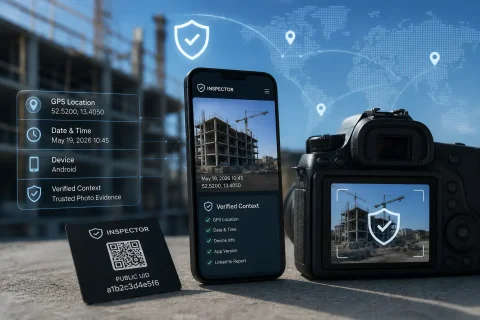

Photo authenticity verification

Verifying a photo's authenticity based on evidential context is a transparent and reproducible mechanism that takes into account shooting conditions, time, location, and other related data available on the user's device.
Online verification of shooting context by identifier
What data is displayed and how it helps verify the context
PUBLIC UID — public photo identifier
A unique identifier used to perform the verification. It unambiguously links the photograph to a record in the system and prevents the results from being replaced by another photo.
client_captured_at — shooting time on the device
Reflects the moment of shooting according to the user's device time. This field allows:
- determining the chronology of events;
- matching the photo with the declared work execution time;
- detecting attempts at backdating.
is_verified — photo integrity status
Shows whether the photo has been altered after shooting.
- true — the image has not been changed after creation in the app;
- false — the photo has been edited or re-saved after shooting.
Important: the false value does not mean the context is unreliable, but indicates that the visual integrity of the image has been compromised.
timezone — shooting time zone
Displays the time zone in which the shooting time was recorded. This allows correct interpretation of time data and eliminates errors associated with different time zones.
lat and lon — shooting coordinates
Latitude and longitude recorded at the moment of shooting. Used for:
- verification of spatial context;
- matching the photo with an object or inspection area;
- analysis of the logical consistency of routes and actions.
gps_accuracy — coordinate determination accuracy
Shows the location determination error in meters. Allows assessing the reliability of coordinates and understanding the conditions under which they were obtained.
address — shooting address
Displayed as a string address determined at the moment of shooting. Used for human-readable verification and matching with the declared work location.
model — device model
Allows understanding on which device the shooting was performed. This is important for:
- analysis of data acquisition conditions;
- detection of anomalies;
- confirmation of the use of a real mobile device.
platform — device operating system
Specifies the OS on which the application was running during shooting (e.g., Android or iOS). Helps correctly interpret the specifics of data collection.
app_version — application version
Records the version of the application in which the photo was taken. This allows accounting for changes in data recording logic between versions.
created_at — record creation
The moment of creating a record in the system. Used to verify the consistency of server time and client data.
updated_at — record update
Shows whether the record has been updated after creation. This helps understand if metadata changes have occurred and at what point.
The obtained fields collectively form an evidentiary context of the shooting, which allows separating the verified facts from interpretations and assumptions.
What does "photo authenticity verification" mean
The app deliberately separates the verification of the photo's context from:
- image analysis using AI;
- searching for traces of pixel editing;
- subjective assessment of the image's content.
The app's task is to provide the user with verifiable and reproducible evidence, not interpretations.
What can be checked on a photo
1. Shooting context
- the time of image creation;
- the sequence of events before and after shooting;
- the photo's connection to a specific report, task, or event;
- the continuity of the recording chain (when and by whom actions were performed);
- the photo's compliance with the declared shooting purpose.
2. Photo shooting conditions
- that the photo was taken by the user and not uploaded externally;
- that the shooting took place within a recorded scenario;
- that the photo was obtained at a specific moment and not backdated;
- that the user's actions during shooting complied with the defined process.
- report photos;
- photo documentation of completed works;
- inspections, checks, audits;
- documentation of object conditions.
3. Related data (evidentiary context)
- user actions before and after shooting;
- the logic of transitions between process steps;
- the fact of saving, transmitting, and using the image;
- the immutability of the recorded context after the photo creation.
What cannot be verified from a photograph
1. Image Content
- that the depicted object is 'real';
- that the event in the photo happened exactly as the viewer interprets it;
- that there are no staged elements in the photograph;
- that the image cannot be visually imitated.
2. Absence of Pixel Editing
- that the image has not been processed with graphics editors;
- that there are no traces of correction in the image;
- that the photo is 'original' in the technical sense.
3. Intentions and Interpretations
- the motives for actions;
- the causes of what happened;
- the legal rightness of the parties;
- the assessment of the event's consequences.
How we prove the authenticity of the shooting context
Principle
Stages of Forming Evidential Context
- Scenario Recording — the photo is taken not randomly, but within a specific action.
- Sequence Control — the user's actions are recorded in a logical chain.
- Link to the Inspection Object — the photo is tied to a specific task, object, or report.
- Immutability After Creation — the context cannot be rewritten retroactively.
- Reproducibility — an independent party can understand how and under what conditions the photo was taken.
How Context Verification Differs from AI Analysis
| Context Verification | Image Analysis |
|---|---|
| Checks conditions | Analyzes pixels |
| Process-based | Probability-based |
| Reproducible | Often non-deterministic |
| Explainable | Model-dependent |
| Suitable for reports | Suitable for filtering |
Where is this applied in practice
Inspections and Checks
- photo reports on the condition of objects;
- control of work execution;
- technical inspections;
- inspector checks.
Business and Contractors
- confirmation of service completion;
- reports for clients;
- resolution of disputable situations;
- control of remote performers.
Journalism and Research
- confirmation of photo origin;
- verification of material acquisition conditions;
- distinction between facts and interpretations.
Legal and Expert Environment
- preliminary assessment of photographic evidence;
- analysis of accompanying conditions;
- exclusion of context substitution.
Method Limitations
- context is not equal to truth;
- a photograph does not prove the entire event;
- any conclusions require interpretation;
- the method is not intended for visual expertise.
Summary
- separate facts from assumptions;
- confirm shooting conditions and process;
- record evidentiary context;
- honestly show what can and cannot be proven.