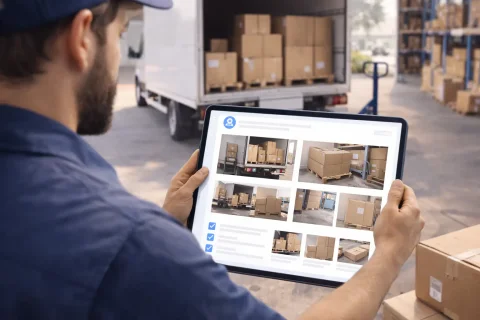

Photo Report in Logistics and Delivery

A photo report in logistics and delivery documents cargo condition and confirms handover. Reduces disputes and enhances control.

Photo Report in Logistics and Delivery

What is a photo report in logistics and delivery

A photo report in logistics and delivery is a structured document in which photos are used to document cargo condition and confirm actions related to its handover, transport, or receipt. Its purpose is to preserve visual data in a convenient form and link it to a specific stage of the logistics process. Unlike scattered snapshots in messengers or on an employee's phone, such a report is compiled according to the logic of the operation. What matters is where exactly the photos were taken, what they show, which shipment or delivery they belong to, and what conclusion can be drawn from them. This is what makes a photo report a full-fledged working document. This format is especially useful in situations where it is necessary to confirm not only the fact of delivery but also the condition of the cargo at the time of handover. It helps to use photos as part of internal control, evidence base, and operational reporting.

Create a photo report for your use case

Use the service to prepare a photo report for a similar task and see how it works in practice.
Create a photo report without registration
If you want to create full-featured photo reports in the dashboard — top up your balance in your user profile.

When a photo report is used in logistics

A photo report is needed in situations where it is important not just to move cargo but to document the condition of the goods and actions at different stages of logistics processes. Below are the main scenarios where this format is particularly useful.

Cargo handover between parties

This is one of the most common cases. When goods are handed over from the shipper to the carrier, from the warehouse to the courier, from the contractor to the customer, or from the logistics service to the final recipient, it is useful to document the condition of the cargo at the time of handover. In this case, a photo report helps: Such documentation is especially important for expensive, fragile, bulky, or sensitive shipments.

Proof of delivery

After delivery, it is often necessary not just to mark the status "delivered" but to confirm the actual handover of the cargo. Visual documentation makes this stage more transparent and understandable. A photo report is useful here because it:
  • confirms the arrival of the cargo at the destination
  • shows exactly what was handed over
  • helps document delivery and unloading conditions
  • can be used in internal and external reporting.
This is especially important for corporate delivery, contractor work, and sites with remote approval.

Documenting cargo condition before and after transport

If there is a risk of damage, deformation, packaging breach, or other change in cargo condition during transit, a photo report helps compare how the shipment looked at different stages. This approach is particularly useful:
  • when working with fragile goods
  • when delivering equipment and machinery
  • for deliveries to construction sites and facilities
  • in international or multi-stage logistics.
In this case, the document helps not only to document the condition but also to analyze at which stage problems might have arisen.

Receiving and unloading on site

When goods are delivered to a warehouse, construction site, retail outlet, customer premises, or production facility, it is important to document the fact of receipt and the condition of the shipment at the time of unloading. This simplifies subsequent work with claims, internal control, and handover of materials within the project.

Mobile field reporting

Photo documentation of cargo and deliveries helps avoid disputes

INSPECTOR can record cargo condition, packaging, seals, damage, and arrival fact with a time and location stamp.

  • Cargo photos at receipt and handover
  • GPS and arrival time
  • Package damage recording
  • Report for warehouse or client

Record cargo and deliveries in INSPECTOR

Take photos of cargo, packaging, and damage, save time and location, then send the report.

Cargo photo inspection appGPS photo for proof of arrivalPhoto evidence

Tasks of a photo report in logistics

A photo report in logistics solves several operational tasks at once. Its value is not limited to simple visual documentation — it helps make the supply chain more manageable and transparent.

Documenting cargo condition

This is the basic function. Photos help show what condition the cargo, packaging, pallet, box, equipment, or batch was in at a specific logistics stage. Such material is especially important if a question later arises about damage, shortage, or violation of handover conditions.

Delivery confirmation

A photo report helps turn the fact of delivery from a status into a visible confirmation. This is especially useful when delivery is controlled remotely or multiple parties are involved. The clearer the confirmation, the easier it is to resolve operational issues without unnecessary correspondence.

Supporting analysis and internal control

If problems regularly arise in the supply chain, photo reports help identify recurring situations: packaging damage, errors during unloading, improper stacking, violations at the warehouse or during handover. That is why these documents are useful not only for a specific delivery but also for systematic improvement of logistics processes. Ultimately, a photo report makes processes more transparent and controllable, and the logistics operations themselves better documented.

What photos are needed for a logistics photo report

For the document to be truly useful, it should include not just any images but photos that help understand exactly what happened to the cargo at a specific stage. A good logistics report typically combines several types of shots.

Overall view of the cargo

First, it is useful to show the cargo as a whole: boxes, pallets, packaging, storage location, or overall view of the batch. Such shots set the context and allow understanding the volume, type, and form of the shipment. Without an overall view, the document may be perceived as too fragmented.

Packaging and labeling

If the condition of the packaging, presence of damage, seal integrity, labeling, tags, or identifiers are important for logistics, it is useful to document these elements separately. This is especially important in cases where verification or analysis of a disputed situation may later be required.

Problem areas and damage

If packaging is damaged, cargo is damaged, deformed, wet, dirty, or has other signs of an issue, this should be documented in close-up and clearly. These are the photos that most often become the basis for analyzing claims and discrepancies.

Photos during handover, loading, or unloading

In some cases, it is useful to show the process itself: how the cargo is positioned, how unloading is proceeding, in what condition it was handed over on site or to the recipient. This helps preserve context and confirm handover conditions. Such images are especially useful in contractor logistics and deliveries to sites.

Final documentation at the delivery location

After delivery is completed, it is important to document how the cargo looks at the recipient's site or facility. This helps show the final condition and confirm the completion of the stage. Ultimately, a good photo report in logistics combines overall context, evidentiary details, and capture of key handover moments.

How to properly create a photo report in logistics and delivery

For a logistics photo report to be useful not only at the time of shooting but also later, it is important to structure it correctly. The photos themselves are valuable, but it is the formatting that makes them a working document.

  • First, a clear sequence must be built. It is usually most convenient to follow the logic of the operation: loading, condition before dispatch, arrival, unloading, receipt. If there are several stages, the user should see this route inside the document.
  • Second, it is useful to group photos by meaning. This could be division by batches, locations, stages, packaging, problem areas, or handover points. Such a structure simplifies analysis.
  • Third, captions should be added. Even a brief explanation helps understand what exactly is documented: packaging before dispatch, corner damage to a box, pallet during unloading, labeling, condition of goods after delivery, and so on.
  • Fourth, it is important to use a uniform format. When reports for different shipments are formatted the same way, they are easier to compare and use in regular work.
  • Fifth, the document should not be overloaded with duplicate photos. Fewer but more informative is better — especially in processes where reports need to be reviewed regularly.
As a result, a well-formatted photo report helps not only to preserve images but also to use them in actual logistics management.

Structure of a photo report on cargo delivery or handover

The structure of the document should help quickly understand exactly what happened at each stage and what the condition of the cargo was. The following approach is practical and convenient.

Introductory part

At the beginning, it is useful to indicate which delivery, batch, site, or route the report relates to. This helps immediately establish context and makes the document suitable for archiving and later retrieval. Typically, the following are indicated here:
  • type of cargo or shipment
  • date
  • handover point or site
  • brief context of the operation.
This part lays the foundation for the entire document.

Documentation of condition before handover

Next, it is useful to show what condition the cargo was in before dispatch or handover to the next party. This creates a starting point for comparison and helps in case of a dispute over quality or integrity.

Main block by logistics stages

After that, it is convenient to place photos by stages: loading, arrival, unloading, placement on site, receipt. If logistics is multi-stage, the material can be divided by route points. This approach makes the document especially useful for complex shipments.

Problem areas and remarks

If there are damages, discrepancies, questions about packaging, or other remarks, it is better to highlight them in a separate block. This facilitates reading and helps get to the heart of the problem faster.

Final part

At the end, it is useful to briefly state the result: delivery confirmed, cargo accepted, remarks recorded, additional inspection required, or other action. Such a structure makes the document a full-fledged working tool, not just a collection of photos.

Common mistakes in logistics photo reports

Even if employees take photos at all stages, the document may work poorly if it is compiled without considering the real tasks of logistics. Below are the mistakes that most often reduce its value.

No link to the handover stage

If it is unclear from the report at exactly which stage the photo was taken, the document loses some of its power. In logistics, the time and point of handover are often critical. Therefore, linking to the stage is particularly important.

Insufficient overall context

If the document contains only close-ups but lacks an overall view of the batch, pallet, packaging, or handover location, it is difficult to understand the full picture. This reduces the evidentiary value of the report. Context is especially important in disputes over volume and condition of the cargo.

Too few explanations

Without captions, it is difficult to quickly understand what exactly is shown in the image and why this shot is important. This is especially inconvenient if there are many shipments and different people review the documents. Brief explanations significantly improve the usability of the report.

Overload with similar images

If the document contains too many nearly identical photos, analysis becomes tedious. Instead of a strong working report, you get an overloaded archive. It is much more useful to select images by meaning rather than by quantity.

No separate highlighting of remarks

If problem photos are mixed with general ones, critical details can be lost. In logistics documents, it is useful to clearly separate ordinary documentation from remarks and disputed areas. Only then does the report work well both as evidence and as an operational document.

How to prepare a photo report in logistics online

Using the service allows you to avoid manually collecting materials from different devices and chats and instead form a unified document in one process. This is especially convenient if there are many shipments, several employees are involved, and the photo reports themselves are needed regularly. The process usually looks like this:

  1. First, photos are taken at the necessary stages with clear logic.
  2. Then, if the INSPECTOR mobile app was not used, the images are uploaded to the system and linked to a specific delivery or handover.
  3. Next, the photos are sorted by stages, zones, or documentation types.
  4. If necessary, captions and explanations are added.
  5. The finished document is generated for handover, archiving, or internal control.
This approach helps reduce manual work, improve the structure of materials, and make logistics documentation more systematic.

Advantages of a digital photo report for logistics

In logistics, it is especially important to document quickly and use data quickly. That is why the digital format here provides not just convenience but a real operational advantage.

  • First, it speeds up the collection of materials. There is no need to manually forward images between participants and then assemble them in scattered files.
  • Second, the digital format helps maintain a uniform standard. This is important if warehouses, couriers, logisticians, contractors, and managers are involved.
  • Third, it simplifies working with large numbers of photos. When images can be sorted and grouped, even a large shipment remains structurally understandable.
  • Fourth, the final document is easier to use subsequently: hand over to the customer, attach to a claim, save in delivery history, or use for internal analysis.
As a result, a digital photo report makes the logistics process more transparent, manageable, and evidentiary.

Where this format is especially useful

A photo report in logistics and delivery is especially useful where it is necessary not just to transport cargo but to document its condition and the fact of handover at every significant stage.

Warehouse and transport logistics

In these scenarios, it is important to see in what condition the cargo was received, stored, shipped, and handed over further. A photo report helps maintain clarity at all handovers of responsibility.

Delivery to sites and construction areas

If materials, equipment, or batches arrive at a site, it is important to confirm not only the fact of arrival but also the condition of the shipment during unloading and receipt.

Working with contractors and carriers

When the logistics chain involves several parties, photo reports help document handover and reduce the risk of disputes over damage, shortages, and quality of performance.

Claims and disputed situations

If questions arise about the condition of the cargo, the presence of visual documentation greatly simplifies analysis. It is in such cases that the value of a photo report is especially evident.

Mass shipments and regular reporting

When logistics operations are repeated regularly, the uniform format of photo reports helps control the process more quickly and compare different shipments with each other.

Guides used

To compile such a report faster and make it useful not only for documentation but also for further work, it is helpful to rely on related materials. They help build a more stable process for working with logistics photos.

  • How to add photos to a photo report — helps gather all necessary images in one place and not lose important materials across shipment stages. This is especially useful when a single operation involves many shots.
  • How to create a photo report online — shows the general scenario for preparing the document digitally. This approach is especially convenient for regular logistics work and distributed teams.
  • How to export a photo report — helps prepare a ready file for handover, archiving, or use in a disputed situation. This is important if materials need to be quickly sent to other participants in the process.
Together, these guides simplify the collection, formatting, and subsequent use of a logistics photo report.

Functions used

For preparing a photo report in logistics, functions that help quickly work with large volumes of images and assemble them into a clear structure are especially important.

  • Mobile work — allows taking and using photos directly during handover, loading, unloading, or delivery. This is especially important in field conditions where speed and on-site documentation are critical.
  • Uploading photos — needed for quickly transferring materials into the system and further working with them. Without this function, it is difficult to build a stable process for regular shipments.
  • Batch actions with photos — especially useful in logistics where there can be many images per operation. They help sort, group, and prepare materials for the final document more quickly.
If these functions are used together, the report is not just assembled but truly convenient for control, handover, and archiving.

FAQ

It is used to document cargo condition, confirm delivery, document handover, and reduce the number of disputes between process participants.
It usually includes an overall view of the cargo, photos of packaging and labeling, shots during handover or unloading, and documentation of problem areas or damage.
Yes, if there is a risk of a change in the cargo's condition, this approach helps understand more precisely at which stage the problem occurred.
Yes, a photo report is especially useful in disputed situations because it helps preserve a visual basis for analysis.
Yes, this is one of the most convenient scenarios. The uniform format of photo reports helps maintain a standard and control logistics operations more quickly.